Actuator Trust
Non-Bypassable Authorization Before Physical Execution
A trust decision matters only if the robot cannot bypass it on the way to the motors.
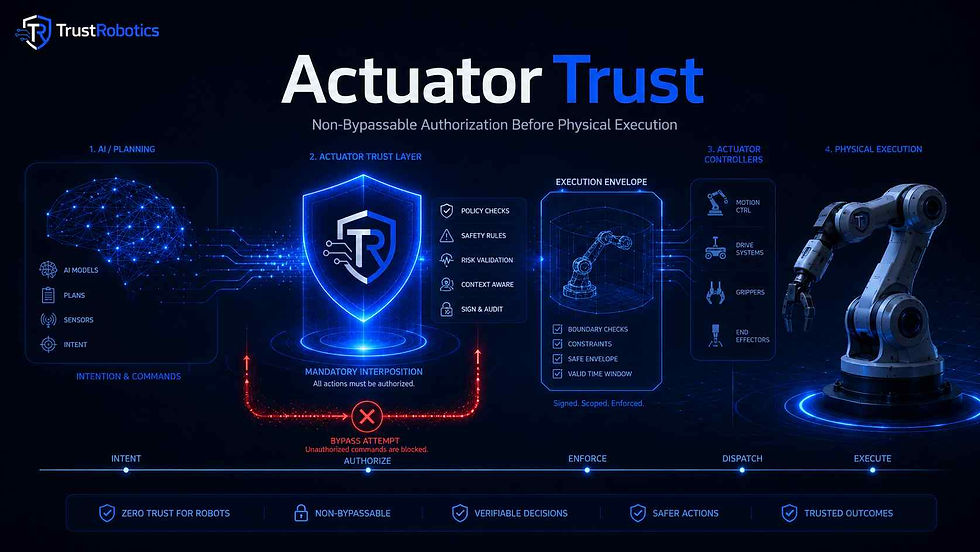
A robot safety or policy system can make the correct decision and still fail if another software path can send commands directly to the actuators. TrustRobotics™’ Actuator Trust architecture addresses this problem by making execution authorization part of the actuator-dispatch path itself.
.jpg)
The central concept is mandatory interposition. An AI action generator, planner, agent, or model produces a candidate physical action, but does not automatically receive the right to execute that action. A runtime enforcement layer evaluates the action and, when appropriate, generates an authorization associated with the current action, state, policy, robot, actuator, or mission. The actuator-dispatch layer then requires valid authorization before corresponding commands are permitted to proceed.
This authorization can define an execution envelope rather than merely a binary approval. For example, an arm action can be limited by joint velocity, torque, end-effector force, workspace region, permitted object contact, body region, duration, or human-proximity condition. A locomotion authorization can constrain speed, route, foot-placement region, balance margin, or operating zone. A gripper authorization can constrain closure speed, grip force, slip threshold, or object-deformation limits.
The architecture is intentionally implementation independent. Authorization can be represented by a signed token, dispatch lease, capability object, secure register value, hardware latch state, trusted process state, session key, or another machine-verifiable mechanism. Enforcement can occur in middleware, an operating-system service, a driver boundary, real-time controller, secure microcontroller, firmware layer, actuator controller, or hardware interface.
The important property is architectural: an AI-generated action should not have an unmediated path to physical execution when that action is subject to TrustBoundary™ governance.
This does not mean every motor-current update or reflex must wait for a high-level policy decision. TrustRobotics™ distinguishes governed AI-generated actions from native servo control, emergency safety functions, and preauthorized reflexes. A reflex can execute rapidly inside an approved authority envelope while higher-level TrustBoundary™ governance determines the scope in which that reflex is allowed to operate.
Actuator Trust therefore provides the enforcement foundation beneath predictive validation and policy governance. Predictive systems can determine what is likely to happen. Policy systems can determine whether an action should be permitted. Actuator Trust determines whether that decision is actually binding at the point where software becomes physical motion.
For OEMs, the value is a defensible separation between artificial intelligence and final actuator authority. For enterprises and regulators, it creates an auditable point of control. For TrustRobotics™, it is a foundational component of the TrustBoundary™ platform.
Because authorization is state-bound, permission can change when the world changes. An authorization can expire when a person enters a protected zone, an object moves, a mission state changes, a foot loses contact, insurance lapses, or a policy version changes. The system can then revoke, narrow, renew, or replace the execution envelope. This makes authorization dynamic rather than a one-time credential and connects high-level governance directly to the robot’s changing physical state.
Partner with
TrustRobotics
Integrate the industry's premier
AI-to-actuator safety layer.
Accelerate Open Development
Validate & Test Stack
Secure Commercial Licensing