The Uninsurable Robot: Bridging the Liability Gap in Physical AI


Tech hyperscalers and robotics OEMs are spending billions to scale the generative “brains” of the next generation of autonomous hardware. Vision-Language-Action (VLA) models are allowing humanoids and mobile agents to fluidly navigate unstructured human environments.
But as advanced robotics move out of laboratory cages and onto trade show floors, corporate event spaces, and municipal sidewalks, the industry faces an invisible brick wall: catastrophic liability.
When an upstream, non-deterministic AI model encounters a prompt injection, a critical network lag, or an edge-case hallucination, a software crash isn’t just an error log—it’s a real-world physical hazard. Legacy functional safety standards (like ISO 10218 or R15.08) were engineered for mechanical component failures and physical barriers, not the cognitive unpredictability of deep learning.
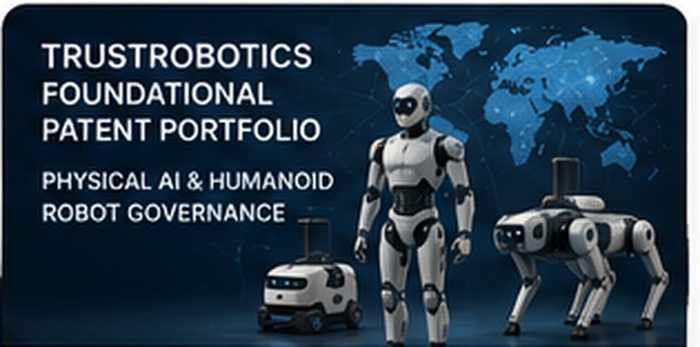
At TrustRobotics, we are engineering the mandatory financial and operational infrastructure that makes advanced autonomy insurable.
Enforcing the TrustBoundary™
Instead of trying to force-fit rigid mechanical rules to fluid software models, the TrustRobotics platform introduces a downstream, deterministic hardware firewall operating directly between the unconstrained AI planning loop and low-level motor controllers.
Before any proposed trajectory token ever mutates a physical joint actuator, it must be programmatically cleared through our edge-anchored validation pipeline.
The future of physical AI isn’t about building better cages—it’s about building a deterministic “Skull” to encapsulate the general-purpose brain. By tying legal, financial, and safety constraints directly to microsecond kinetic alterations, we are opening the door for safe, zero-liability public deployments today.
Whether you are scaling an enterprise manufacturing fleet, launching consumer activation layers, or designing next-gen bipedal kinematics, hardware autonomy demands a verifiable trust boundary.
Are you building a physical AI platform? Let’s connect. Explore our core standard specifications, reference implementations, and dual-licensing developer architecture at trustrobotics.ai.


Comments