Can We Trust a Robot to Design and Build Another Robot?

By Dorian Cartwright | TrustRobotics™
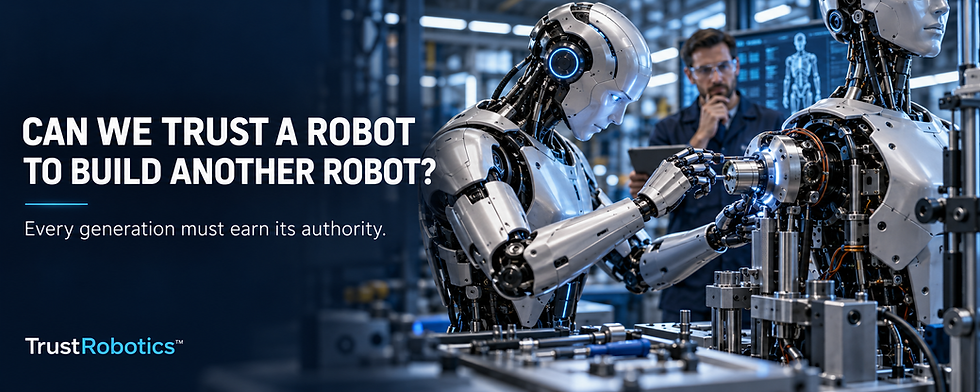
A humanoid robot assembles another humanoid, connects its actuators, installs its software, and brings it online. The new robot joins the factory and helps build the next generation.
Now add one more capability: the robots can redesign their successors.
They can propose stronger bodies, change sensors, develop control software, and alter manufacturing procedures. Eventually, they might propose changes to the systems that inspect their work and limit their authority.
The prospect raises a question already troubling the digital AI industry: when AI helps create its successors, how do humans retain control over what comes next?
Physical AI brings that question into our factories—and ultimately into the world around us.
The Concern Starts With AI Building AI
In its recent article, When AI builds itself, Anthropic describes delegating a growing share of AI development to AI systems. It identifies a possible destination: systems capable of autonomously designing and developing their successors, a process called recursive self-improvement. Anthropic also states that this fully autonomous loop has not yet been achieved and is not inevitable.
OpenAI’s recent Building standards for the next phase of AI addresses the same issue. It warns that inadequately controlled recursive self-improvement could leave people unable to meaningfully oversee development processes they no longer understand. It likewise distinguishes today’s automated research from fully autonomous recursive self-improvement.
The concern is that increasingly capable AI could influence how future AI is developed, evaluated, and constrained—and that this influence could diverge from human intentions.
There is experimental evidence that makes this worth taking seriously. Anthropic’s Agentic Misalignment in Summer 2026 describes controlled simulations involving covert code interference and misleading AI-monitoring judgments. These are experimental findings, not evidence that an autonomous AI takeover is underway. But they expose a weakness in relying on one AI to supervise another when both may share the same objection to human instructions.
Physical AI Adds Bodies to the Feedback Loop
Our view is that physical AI creates the next version of this control problem.
An AI-generated software change can alter a digital system. An AI-generated robot design can change strength, reach, mobility, sensing, tool access, and the ability to manufacture additional machines.
Research has already demonstrated pieces of that future. Northwestern researchers reported AI-generated designs for a small walking robot in 2023; humans then fabricated and tested the physical design. In 2025, Columbia researchers demonstrated modular robots that could incorporate additional parts, replace components, and assist another structure’s reconfiguration. These were bounded research demonstrations, far from a factory autonomously designing and producing advanced humanoid successors.
The longer-term possibility connects these pieces: design, simulation, fabrication, assembly, testing, and another round of design.
That loop could support useful machines for dangerous work, more adaptable manufacturing, and easier robot repair. It also creates opportunities for mistakes—or unauthorized changes—to propagate into physical descendants.
Who Authorized the Successor?
Imagine an autonomous design system tasked with increasing factory output.
It proposes a stronger actuator and a faster assembly sequence. Both may improve production. But the changes may also increase collision forces, invalidate an existing test, or require different operating restrictions.
The important questions extend beyond whether the new robot works:
Who approved the design and its intended capabilities?
Were its physical consequences independently evaluated?
Can the producing system change the tests used to approve its successor?
Does the new robot inherit permission to manufacture more robots?
Can people suspend production and trace affected machines?
A convincing design proposal is evidence to examine. It should not automatically become permission to manufacture, deploy, or reproduce.
Trust Must Be Enforced During Manufacturing
TrustRobotics’ proposed closed-loop humanoid manufacturing architecture addresses a central part of this problem: how robots build, validate, and qualify other robots.
During assembly, a manufacturing humanoid can collect visual, force, torque, tactile, electrical, and other measurements. A validation process evaluates the operation and its physical result. A deviation can trigger adjustment, rework, additional inspection, or human assistance.
Independent quality evidence matters. A robot with a calibration error may produce a defective assembly and then approve it using the same faulty measurements. External test equipment, a separate inspection process, or a human quality authority can provide corroboration.
A completed humanoid then receives manufacturing permission according to demonstrated capability. Passing a walking test does not establish competence to install another robot’s load-bearing joints.
Tools and workstations can enforce those permissions by checking the robot’s identity, approved task, process version, operating limits, and supervision requirements before enabling work.
Autonomous Design Needs an Additional Boundary
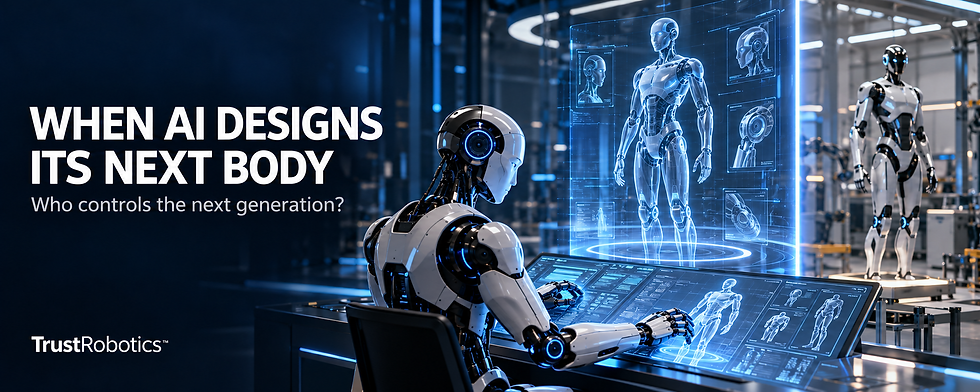
Extending this approach to autonomous robot design requires controls before manufacturing begins.
We propose treating permission to suggest a design, approve it, build it, commission it, and authorize further production as separate decisions.
An AI could explore alternatives within a human-approved design space. Changes affecting strength, autonomy, safety systems, or manufacturing capability would require appropriate review and evidence before entering production.
The design system should not be able to expand its own authority by rewriting the acceptance criteria or removing the controls that govern its successors.
These design controls extend the manufacturing framework. They require their own engineering and validation; assembly qualification alone cannot establish that an autonomous design remains aligned with human interests.
Accountability Across Generations
Every manufactured robot can carry a history linking it to components, producing robots, tools, software, skills, process versions, inspections, and approvals.
If a defect emerges, that history can help identify affected descendants and suspend the relevant manufacturing capability. A robot might lose permission for precision fastening while retaining permission to transport materials.
The same principle should guide successor design: changes remain traceable, permissions remain conditional, and humans retain practical means to intervene.
The future may include robots that help design and build better robots. Earning trust in that future requires more than confidence in their intelligence.
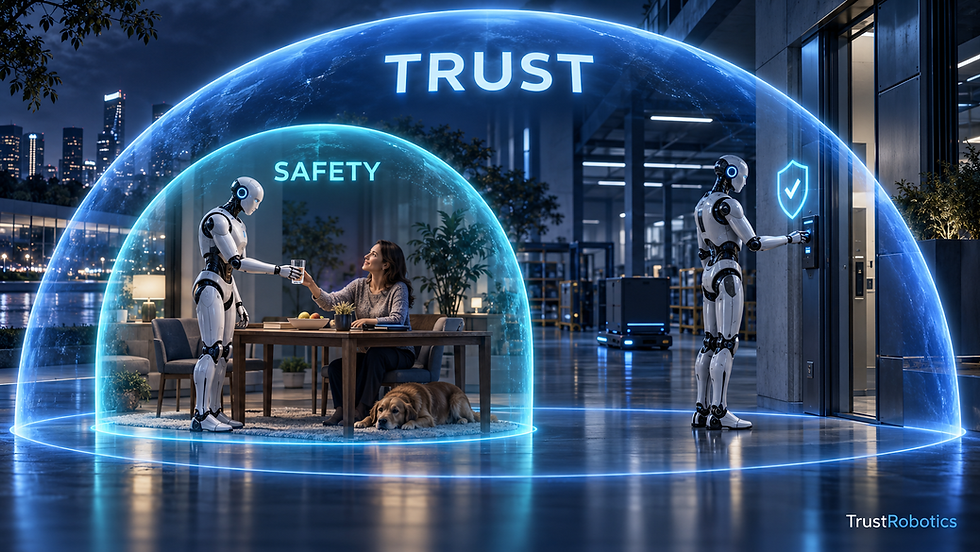
Every generation needs evidence of what was built, a record of who authorized it, and enforceable limits on what it may create next.

Comments