The Self-Repairing Access Point: When the Network Can Call a Robot

By Dorian Cartwright | TrustRobotics™
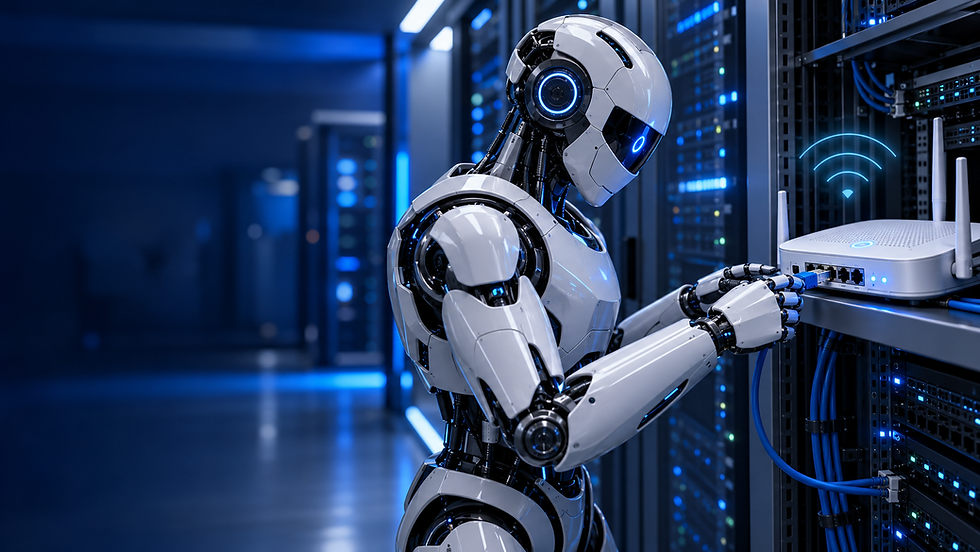
A wireless access point can detect lost connectivity. But when the cause is a disconnected cable, displaced antenna, or overheated device, restoring service may require someone to physically intervene.
What if the network could arrange that intervention itself?
TrustRobotics’ patent-pending technology explores an access point, controller, router, or gateway that can coordinate physical diagnosis, select an authorized robot, arrange remediation, and verify whether service was restored or improved. The access point becomes a gateway between digital intelligence and physical work.
From detecting a problem to fixing its cause
Consider an office access point experiencing repeated connection failures. A digital AI agent reviews the available telemetry and requests a physical result: investigate the failure and restore connectivity within specified limits. The request does not need to identify a particular robot or contain manufacturer-specific movement commands.
The network infrastructure determines the required capabilities and selects an eligible robot. A mobile robot might inspect the equipment, photograph indicator lights, measure temperature, and check the cable connection.
If the evidence supports a loose connection, the infrastructure can authorize a robot with the appropriate manipulator to reconnect it. Network measurements then establish whether the intervention restored service.
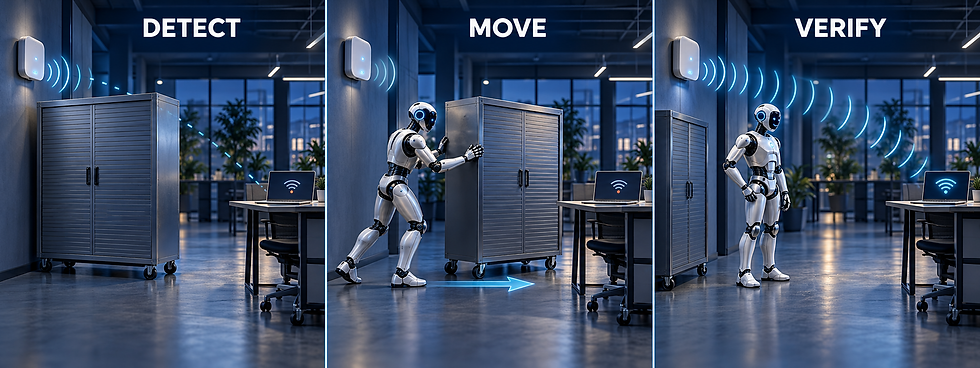
Detect the condition. Investigate the physical cause. Authorize remediation. Verify the outcome.
Repair the network—or improve the world around it
The architecture addresses both restoring service and improving network performance. An access point or controller can combine network telemetry with robot-acquired observations to identify physical conditions limiting performance: an obstructed antenna, poorly positioned equipment, a movable barrier, a damaged cable, or excessive heat.
Once the cause is identified, the infrastructure can arrange an authorized physical change. A robot could reposition an antenna, move permitted equipment or an obstruction, reconnect a cable, replace a permitted component, or deploy a temporary relay.
Network measurements then verify whether the change improved coverage, throughput, latency, or reliability. The network can diagnose its physical environment, arrange changes to that environment, and measure whether those changes deliver better service.
A dedicated service robot or Robot-as-a-Service
The work could be performed by a dedicated AP service robot stationed on the premises or by a Robot-as-a-Service (RaaS) provider supplying an eligible robot on demand.
A digital AI agent requests the desired result—such as restoring connectivity or improving coverage—through the network’s physical-service interface. The infrastructure resolves the required capabilities, selects an authorized robot, governs dispatch, and evaluates evidence that the requested result was achieved.
A common service interface supports different robot platforms while robot-specific adapters translate authorized services into supported tasks. This approach could make physical network maintenance available both to facilities with their own robots and to businesses that obtain robotic service when needed.
Repairing itself—and the equipment around it
“Self-repairing access point” describes one application of a broader architecture. The serviced equipment could be the requesting access point itself. It could also be a switch, server, client device, antenna, cable, or other equipment within the authorized physical-service domain.
The network infrastructure brokers the work. The robot supplies physical sensing and manipulation. A digital AI agent can request an outcome without receiving the robot’s native control credentials.
For example, “restore connectivity in this room” can become a governed service request. The infrastructure determines which observations and interventions are permitted, which robot can perform them, and what evidence will establish completion.
Keeping the network available during repair
Physical repair may take time. Another robot could temporarily provide connectivity while the affected equipment is inspected or serviced.
TrustRobotics’ complementary patent-pending architecture addresses temporarily assigning a robot a network-infrastructure role, such as an access point, relay, bridge, or mesh node. That role has limits: permitted traffic, service scope, location, duration, and operating conditions.
When the temporary service ends, the system coordinates continuity and withdraws the robot’s infrastructure authority. Together, these capabilities could let a network maintain service while addressing the physical cause of an outage.
Why data-center robotics matters
The commercial direction is already visible. In an August 28, 2026 report, WIRED described Meta testing robots from Watney Robotics, Kinova, and ABB for tasks including cable work, server power cycling, and hardware reseating. These reported experiments illustrate demand for robotic maintenance around computing infrastructure.
These activities raise an architectural question: how should software request physical work across different robot platforms? TrustRobotics’ proposed approach places a common physical-service interface in network infrastructure, allowing the requesting agent to focus on the desired result.
A repair command is not proof of repair
A robot reporting that it pressed a reset button does not establish that connectivity returned. The service therefore needs a completion criterion: restored reachability, acceptable packet loss, recovered backhaul, or another measurable condition.
Evidence is associated with the service transaction and evaluated against that criterion. The returned result distinguishes verified success from failure or an uncertain outcome. Verification can use observations from a source other than the robot that performed the repair.
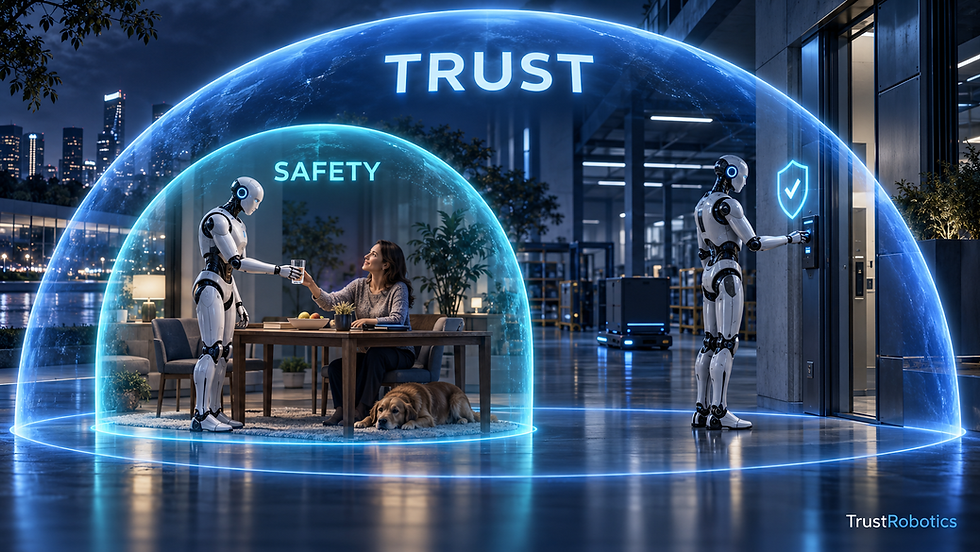
Authority matters throughout. Permission to inspect equipment does not automatically include permission to disconnect it, restart it, or replace a component.
Toward networks that can act
TrustRobotics’ patent-pending technology brings together robot-enabled network infrastructure, temporary robot-provided connectivity, and physical services requested by digital AI agents.
The proposed architecture allows network infrastructure to select capable robots, govern physical interventions, and evaluate evidence that the requested result was achieved. A common service interface supports different robot platforms while keeping robot-control authority separate from the requesting agent.
A future access point could do more than report an outage. It could help arrange the work—and obtain the evidence—that restores service or improves network performance.

Comments